Practical AI
An AI consultant for small business.
Start with one task that wastes time every week. Test it properly before it becomes a subscription you cannot justify.
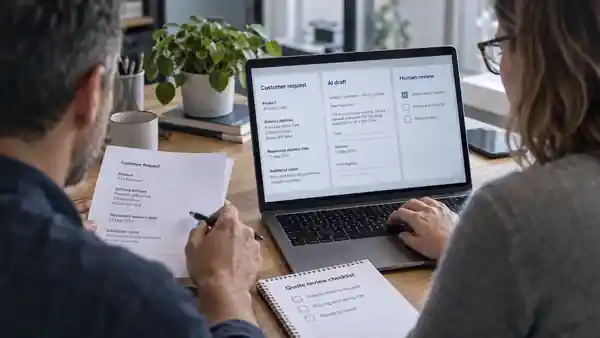
What an AI consultant for small business actually does
An AI consultant for small business is useful when the tools are already everywhere and none of it is measurably helping. Trials accumulate, subscriptions renew, and nobody can say what changed.
The problem is usually not the model. It is that nobody mapped the task before automating part of it.
The work starts with the job, not the product catalogue. What takes too long, how often, and who feels it first.
Smaller teams have less room to be wrong
A large organisation can absorb a failed pilot inside a department budget. A ten-person business feels it in the same month.
That is an argument for measuring first, not for avoiding AI. Bounded tests are cheaper than confident rollouts.
Pick the task, not the technology
Good candidates are weekly, repetitive, and annoying to a specific person. Quoting, intake, scheduling, chasing information, drafting the same document again.
Ask who currently does it, how long it takes, and how often it comes back wrong. Those three answers usually decide the priority on their own.
Avoid starting with the task that is most interesting. Start with the one that repeats.
Count the whole cost, including the boring parts
Licences are the visible cost. Review time, corrections, integration, maintenance and training are the ones that decide whether the change pays.
ZOYA assesses value across the whole task: time spent, repeated work, quality, and full costs. Estimates depend on your inputs and do not establish guaranteed savings.
Per-seat pricing scales with headcount, not with benefit. Check what happens to the bill when the team grows.
Keep a person in the loop where it matters
Anything that touches a customer, a price, or a legal obligation needs a human check. Design that check deliberately rather than discovering you needed one.
Implementation work includes evaluations, human review, documentation and a named owner. A workflow without an owner is a workflow without a warning system.
What working with ZOYA looks like
Start with the free 30-minute workflow review. It covers one workflow and ends with a brief map and a recommended next step.
From there the Operational Diagnostic ranks improvements across the workflow, and the AI Business Case & Pilot tests one opportunity against agreed measures.
If the case holds, implementation and enablement are available as separately scoped work. If it does not hold, stopping is a valid answer.
Capacity is not the same as cash
Time released is capacity. It becomes money only when the freed hours go somewhere that matters to the business.
Decide in advance what those hours are for. Otherwise the saving stays theoretical while the subscription stays real.
Start smaller than feels satisfying
One workflow, one measure, one decision point. That is enough to learn whether this class of tool helps your business at all.
A second workflow is much easier to judge once the first has a real before and after.
Bring the task that wastes the most time.
The free 30-minute review looks at one workflow and gives you a brief map and a next step you can act on.
The full diagnostic report, pilot, implementation and training are separately scoped.
Check readiness before you subscribe.
Expected Illustrative working assumptions; adjust to your task.
- Business value
- 3 / 2 rating / 5
- Available data
- 2.5 / 2.5 rating / 5
- Human review
- 4 / 2 rating / 5
- Full costs
- 3 / 1.5 rating / 5
- Team ownership
- 3.5 / 2.5 rating / 5
Change the inputs